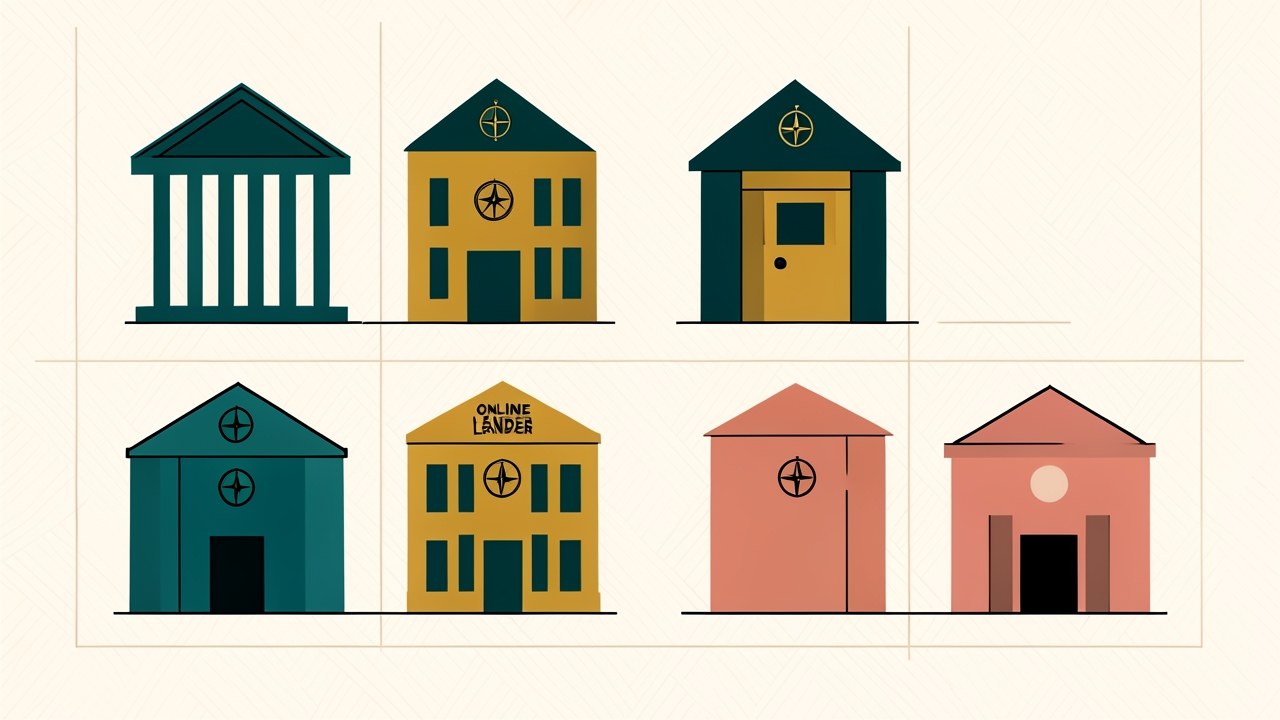
Understanding Your Auto Loan Lender Options
When you finance a car, you have several lending channels to choose from: banks, credit unions, online lenders, and dealerships. Each type has distinct characteristics in terms of interest rates, fees, ownership structure, and convenience. Understanding these differences helps you select the lender that best fits your financial situation.
The lender you choose determines not only your interest rate but also the terms, fees, and level of customer service you can expect. Shopping around and comparing offers from multiple lenders is a key step to ensure you get the best deal.
- Credit unions are not-for-profit cooperatives owned by their members, typically offering lower rates and lower fees.
- Banks are for-profit institutions that may have higher rates and fees.
- Online lenders provide convenience and quick approval, but their fees and terms vary widely.
- Dealerships offer one-stop shopping but may include rate markups that increase your cost.
Sources: Consumer Reports, Energy One Federal Credit Union, Auto-Mattox, Spero Financial
Typical Rate Ranges and Fees by Lender Type
Interest rates on auto loans vary widely based on your credit score, income, and other factors. Experian data for Q1 2026 shows that for new cars, average APRs range from 4.55% for borrowers with superprime credit (781+) to 16.01% for those with deep subprime credit (300-500). For used cars, the range is 6.30% for superprime to 21.77% for deep subprime.
Lender type also influences rates. Credit unions generally offer lower interest rates than banks. One indication of this is that credit unions frequently beat banks on auto loan rates, as noted by Consumer Reports. Dealerships may offer promotional rates through captive finance companies (automaker-owned lenders), but these are often only available to high-credit borrowers and may require sacrificing rebates.
Fees also differ by lender type. Banks may have higher fees, while credit unions generally have lower fees. Online lenders can have a range of fees, including prepayment penalties, so it's important to review the terms carefully.
- Credit unions: lower rates, generally lower fees.
- Banks: higher rates and fees compared to credit unions.
- Online lenders: competitive rates but watch for fees and prepayment penalties.
- Dealerships: convenient but may include dealer reserve markups that raise your effective rate.
| Lender Type | Typical Rate | Fees |
|---|---|---|
| Credit unions | Lower than banks | Generally lower |
| Banks | Higher than credit unions | May have high fees |
| Online lenders | Can be competitive | Possible high fees and prepayment penalties |
| Dealerships | May include markups | May have hidden fees or add-ons |
Sources: Consumer Reports, Experian, Consumer Financial Protection Bureau, Auto-Mattox, Spero Financial
Pros and Cons of Each Lender Type
Choosing a lender involves weighing advantages and disadvantages. Here's a breakdown to help you evaluate your options.
- Credit unions: Pros – lower rates, member-owned, personalized service, often lower fees. Cons – may require membership, fewer branches.
- Banks: Pros – established institutions, wide availability, sometimes offer online tools. Cons – higher rates and fees, for-profit motive.
- Online lenders: Pros – quick approval, convenient, competitive rates. Cons – no physical branch, fees and terms vary, some have prepayment penalties.
- Dealerships: Pros – one-stop shop, convenience, may offer special deals (e.g., low promotional rates from captive finance). Cons – possible rate markups, pressure to finance, may include add-ons.
Sources: Consumer Reports, Energy One Federal Credit Union, Consumer Financial Protection Bureau, Auto-Mattox, Audi Jacksonville, Spero Financial
How to Compare Lender Offers: APR, Fees, and Terms
When comparing auto loan offers, focus on the annual percentage rate (APR), which includes both the interest rate and any fees, as well as the loan term and monthly payment. The APR gives you a more accurate picture of the true cost of the loan than the interest rate alone.
Consider the total interest you'll pay over the life of the loan, not just the monthly payment. A longer term may lower your monthly payment but increase total interest. Also, look for any fees, such as origination fees, documentation fees, or prepayment penalties.
Shopping around and getting quotes from multiple lenders allows you to compare on equal terms. The Consumer Financial Protection Bureau recommends comparing offers from several lenders to ensure you get the best deal.
- APR includes interest and fees, so use it to compare costs.
- Check the loan term: longer terms reduce monthly payments but increase total interest.
- Understand all fees: origination, documentation, prepayment penalties.
- Get quotes from at least three lenders to compare.
Pre-approval: What It Is and Why It Matters
Pre-approval is a process where a lender evaluates your creditworthiness and gives you a conditional loan offer for a specific amount and APR. It is recommended to get pre-approved before visiting a dealership because it gives you negotiating power and helps you know what rate you qualify for.
With a pre-approval in hand, you can compare the dealer's offer against it. If the dealer tries to offer a higher rate, you can counter with your pre-approved rate. The Consumer Financial Protection Bureau suggests that getting prequalified or preapproved is a smart step before shopping.
One concern with rate shopping is the impact on your credit score. However, the CFPB notes that multiple inquiries for an auto loan within a 14-45 day period are counted as a single inquiry, so you can shop around without significant credit score damage.
Sources: Consumer Financial Protection Bureau, Consumer Reports
Questions to Ask Before Choosing a Lender
Before committing to a lender, ask detailed questions to understand the full cost and terms.
Questions can help you uncover hidden fees or unfavorable terms and ensure you are getting the best deal for your situation.
- What is the exact APR, including all fees?
- What is the loan term and the total cost of the loan?
- Are there any prepayment penalties?
- What documents do you need to apply?
- Are there any restrictions on the vehicle (e.g., age or mileage limits)?
- What is the down payment requirement?
- What happens if I miss a payment?
Sources: Consumer Financial Protection Bureau
Direct vs. Indirect Financing: Understanding the Difference
Auto loans can be arranged directly or indirectly. Direct financing means you obtain a loan from a bank, credit union, or online lender yourself, often with a pre-approval. Indirect financing is arranged through the dealership, which acts as a middleman and may mark up the rate.
Direct financing allows you to compare offers and get preapproved, giving you leverage. Indirect financing is convenient but may cost more if the dealer takes a cut. The CFPB notes that dealers can mark up the interest rate as 'dealer reserve,' which is profit for them but a higher cost for you.
Regardless of the channel, understanding the difference helps you negotiate effectively and avoid overpaying.
Sources: Consumer Financial Protection Bureau, Experian
decision-criteria matrix
The table below summarizes the key attributes of each lender type based on the research findings.
| Lender Type | Typical Rate | Ownership | Fees | Convenience |
|---|---|---|---|---|
| Credit unions | Lower than banks | Not-for-profit, member-owned cooperative | Generally lower | Varies; may require membership |
| Banks | Higher than credit unions | For-profit, shareholder-owned | May have high fees | Good branch and online access |
| Online lenders | Can be competitive | Varies (not specified) | Possible high fees and prepayment penalties | High, quick approval |
| Dealerships | May include markups | Varies (captive finance or third-party) | May have hidden fees or add-ons | High, one-stop shop |
Sources: Consumer Reports, Energy One Federal Credit Union, Consumer Financial Protection Bureau, Auto-Mattox, Audi Jacksonville, Spero Financial
Frequently asked questions
Which type of lender usually offers the lowest rates?
Credit unions typically offer the lowest auto loan rates. Consumer Reports notes that credit unions frequently beat banks, and Spero Financial also states that credit unions offer lower rates than the national average. This is because credit unions are not-for-profit cooperatives owned by their members, which allows them to pass on savings in the form of lower rates and fees.
Sources: Consumer Reports, Spero FinancialIs it better to get a loan from a dealership or a bank?
It depends on your individual circumstances. Dealerships offer convenience as a one-stop shop, but they may mark up the interest rate (dealer reserve) to increase their profit, as highlighted by the Consumer Financial Protection Bureau. Banks may have higher rates and fees compared to credit unions, but they offer established service and are for-profit institutions. Shopping around and comparing offers is key: getting pre-approved from a bank or credit union can give you leverage when negotiating at the dealership.
Sources: Consumer Reports, Consumer Financial Protection Bureau, Spero FinancialHow do online lenders compare to traditional banks?
Online lenders offer convenience and quick approval, which can be a significant advantage. Consumer Reports notes that online lenders can provide rapid, competitive quotes. However, online lenders may have high fees or prepayment penalties, and their rates and terms vary widely. Traditional banks are for-profit institutions and may have higher rates and fees than credit unions, but they offer the benefit of physical branches and established reputation. It's important to compare the APR and fees from both types of lenders for your specific situation.
Sources: Consumer ReportsShould I get pre-approved before visiting a dealership?
Yes, getting pre-approved is highly recommended. The Consumer Financial Protection Bureau advises getting prequalified or preapproved before visiting a dealership. With a pre-approval, you have a known rate and a firm offer, which gives you negotiating power. Consumer Reports notes that walking in with preapproval is your best defense against dealer markups. Additionally, multiple credit inquiries for auto loan shopping within a 14-45 day period count as a single inquiry, so you can shop around without major credit score impact.
Sources: Consumer Reports, Consumer Financial Protection BureauCan I use a personal loan instead of a car loan?
Yes, you can use a personal loan to finance a car, but it's often more expensive. Personal loans are typically unsecured, meaning they don't use the car as collateral, and they usually have higher interest rates and are harder to qualify for, according to Experian. Secured auto loans generally offer lower rates because the vehicle serves as collateral. Using a personal loan might make sense if you can't get an auto loan or if the terms are better, but compare the APR and fees carefully. Given that auto loans are secured and usually have lower rates, they are generally a more cost-effective choice.
Sources: Auto-Mattox, ExperianSources
- How does a lender decide what interest rate to offer me on an auto loan? — Consumer Financial Protection Bureau
- Where to Shop for a Car Loan — Consumer Reports
- Average Car Loan Interest Rates by Credit Score — Experian
- Understanding Auto Loan Interest Rates and APR — Energy One Federal Credit Union
- Can I negotiate a car loan interest rate with the dealer? — Consumer Financial Protection Bureau
- Different Types of Car Loans, Explained — Auto-Mattox
- Understanding Interest Rates on Car Loans — Investopedia
- The Ultimate Guide to Car Financing: Navigating Your Options for the Best Deal — Audi Jacksonville
- Pros & Cons of Car Financing Through a Dealership, Bank, or Credit Union — Spero Financial
- What Are the Different Types of Car Loans? — Experian